


Cross stitch, Needlecraft and Embroidery Glossary: Abby Cloth to Ayrshire work
A comprehensive illustrated needlecraft dictionary with clear definitions and working diagrams. Includes 766 terms used in cross stitch, embroidery, tapestry, blackwork, and goldwork. (Click thumbnails to enlarge.)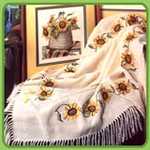
The stitching area is the border around the square center and is 18 count.
Picture courtesy of Zweigart.
They are typically used for throws, baby and cot blankets but can also be used as table covers and a single panel can also be used as a table mat. The edges are normally fringed.
Zweigart manufactures these in several thread counts and styles.
Available Afghans include:- abby, Alba, almanac, anne, augusta, baby snuggle, Country Home, Diamond, Gloria, hearthside, honeycomb, Merino, Mosaik, Novara or Palisade, patrice, Tannenbaum, Teresa and Floba.
Photo courtesy of Zweigart.
Also manufactured by Charles Craft and styles include:- Baby Alphabet, Receiving Blanket, Lady Elizabeth, Nursery Time Baby, Alphabet and Evenweave Throw.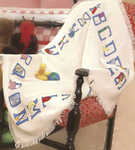
Photo courtesy of Charles Craft.
6 count is 2.45 threads per cm
7 count is 2.8 threads per cm
8 count is 3.25 threads per cm
10 count is 4 threads per cm
11 count is 4.35 threads per cm
14 count is 5.4 threads per cm
16 count is 6.4 threads per cm
18 count is 7 threads per cm.
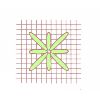
This consists of eight stitches worked from the same centre. It is usually worked in diagonal rows as it is a very open stitch.
Start with top right diagonal stitch, work to centre and then bring needle out again at top to work vertical stitch to centre. Continue round star in this way.
Also known as star eyelet stitch.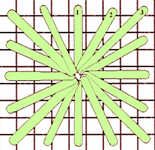
This can also be worked over 8 threads clockwise as shown when there will be sixteen stitches in total.
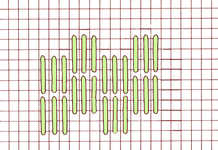 .
.This consists of blocks of three satin stitches over four threads, followed by another block started two threads higher as shown. A variation is Algerian filling stitch with bar where a horizontal stitch is added at the base of each block either in the same thread or a contrasting shade or texture.
Also used in pulled thread work.
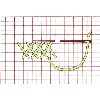
Working from left bring needle through and across three threads to the right and four down, then out two to the left and up across the first stitch, three to the right and four up, through and back left under two vertical threads.
Continue in this way as shown with the next row being worked directly above previous row.
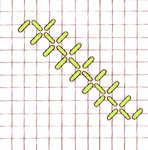
Start this stitch at the lower right hand corner of the area to be filled and work a row of basketweave tent stitch diagonally up to the top of the area. Then work backstitch from top right to bottom left as shown below the row of basketweave tent stitch. Continue working basketweave tent stitch upwards and backstitch downwards until the area is filled.
A very lacy stitch can be achieved by worked over two intersections instead of one.
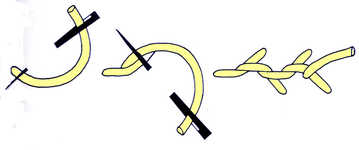
Buttonhole stitches are worked first on one side and then the other along a straight line. Also known as quill stitch.
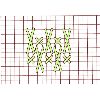
Work from left to right, make small cross over two thread square and oblong cross over 6 threads vertically and two threads horizontally.
Alternate crosses on next row as shown.
Also known as double stitch.
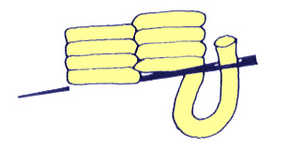
A variation on satin stitch and similar to encroaching satin stitch but where stitches alternate between the columns.
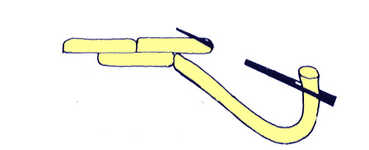
A variation on stem where two rows are worked at the same time with one row being spaced by a half stitch length as illustrated.
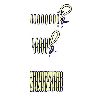
In the free version, make a row of stitches with the space of one between as shown, coming up at A and down at B, up at C and down at D. The second row is worked in the space starting half way up the original stitch, come up at E and down at F. The third row is worked as shown using the same lower hole as in the first row.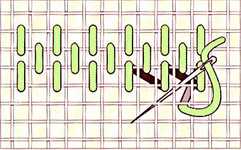
In the counted thread version rows of straight stitches are worked over two threads with a space of two threads between each stitch. The next row is started one thread below the first row. The rows interlock. Also known as brick stitch. See also double brick stitch.
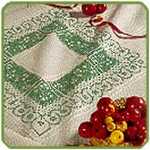
Each square is 5" wide and the stitching area 90 x 90. The fabric comes in 145 cm 57” widths which is seven full panels and leaves a area for fringing at either side.
Available in several colours with white and cream in a choice of 100% cotton or 100% polyacrylic.
Picture courtesy of Zweigart.
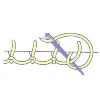
Bring thread through from back of fabric and work a buttonhole stitch loosely pass needle behind loop of stitch and over working thread as shown in diagram.
It can be spaced out to make a lacy edging or worked close together. More rows can be made working over loops of previous rows.
Also known as knot stitch.
In raw edge appliqué banding stitches such as buttonhole, herringbone, couching, trailing, french knots, coral, feather, zigzag chain and open chain stitch are used if working by hand.
There is also reverse appliqué where the top fabric is cut to reveal the fabric or fabrics below.
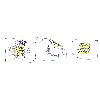
Unravel the raw edges around the finished needlepoint so that single threads appear on all sides as shown. Pin and baste the needle point in position on the background material. With a large eyed needle take each thread through to the reverse side of the fabric. Turn to the reverse side and knot the needlepoint threads together in pairs pulling so that the canvas is held firmly in place. Turn to the right side again and outline the canvas with a edging stitch.
In the diagram stem stitch is shown on side A, couching at B, a couched cord at C and no edging at D.
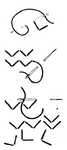
In free embroidery stitches are worked at right angles to one another. The usual method is to work from left to right with slanting stitches, making two stitches on the wrong side on the upward movement. The same effect is obtained by working two parallel rows of backstitches on the wrong side of the work, with the zigzag on the right side; or by working one row of stitches, filling in on the return journey The stitch may be worked also in pairs or vertically. 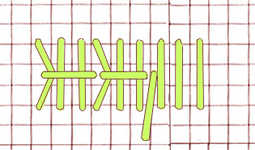
In counted thread three vertical straight stitches are worked over four threads of the fabric and pulled tightly to one side with a small horizontal stitch. It can be used for filling large areas and if there are any gaps at the edges these can be filled in with tent stitch.
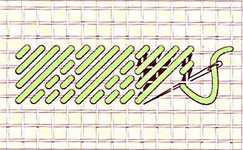
A group of four diagonal stitches are worked over 1,2, 3 and 4 intersections of fabric to form a triangle. Six tent stitches are worked to complete the pattern and form a square.
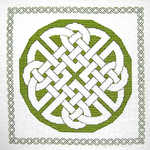 This originated in Northern Italy.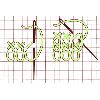
Work a stitch diagonally across two intersections, make a second stitch in the same place but leave a loop of thread. A knitting needle can be used to gauge the length of the loop. Then complete the cross and bring needle out again down and to the right across two intersections ready to start the next stitch.
After all the rows are complete, cut loops and trim evenly.
Also known as velvet stitch, rug stitch, raised stitch, tassel stitch and plush stitch
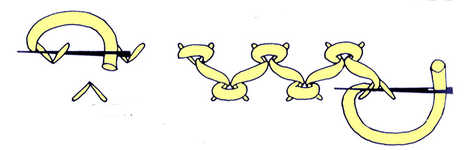
Work two small stitches to make V shapes at regular intervals along two parallel lines. Then zigzag between the lines as shown without the needle entering the fabric. Also known as whipped chevron stitch.
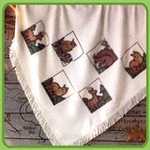
It has a waffle weave pattern which alternates with a plain 14 count cross stitch area.
Picture courtesy of Zweigart.



US Customers
We have an interim delivery system now in operation.Please be aware that the new import tariffs will be applied by US Customs.