Greece Should Default |
The Greeks should default and tell the speculators where to stick their austerity measures.
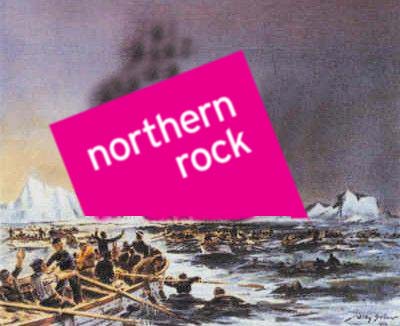
Iceland had a referendum over their own problem with the Icelandic banks and told their government just what they thought of usurious repayments to the British and Dutch - which led to an improved 'offer' from the creditors.
A sovereign default by Greece or any of the other so-called basket cases in the Eurozone is better than the alternative to which we seem to be inexorably headed. Too often in the past, speculators have been paid off by fearful governments who fall for the end-of-civilisation-as-we-know-it propaganda touted by greedy fat rich men.
Like Northern Rock in the UK, the Greeks are the current channel by which the bankers wage war on taxpayers. It didn't take long for the British Government to roll over and rescue Northern Rock. Gordon Brown's pathetic claims that he personally had averted international ruin served only to reassure bankers that they were untouchable.
And so it has proved.
The ECB and other central banks seem to regard the loss of a bank as the very last resort. Clearly this plays into the hands of the speculators.
What would happen if Greece defaulted? Well, it would send signals to Portugal, Ireland, and various others that sovereign default doesn't mean the end of everything.
In fact, it doesn't mean the end of anything - except some banks.
And even then, that would be temporary. Their assets would be sold on by administrators and, as we all need somewhere to keep our money, new banks would take on the business. Except without the crippling level of debt that taxpayers now face.
We might even see some legal action against boards by aggrieved shareholder groups.
Ultimately, however, it would encourage countries to end reckless borrowing and banks to end reckless lending, which is what got us into this mess in the first place.
|
| |
| by The Impressionist on Mon, 27 Jun 2011, 13:43 |
|
|
|
The Strange World of Overseas Card Payments |
As the rest of the world seems to have been constantly banker-bashing for a couple of years, The Impressionist thought it would be a good time to jump on the bandwagon.
We, like many others, use a plastic card to buy things from overseas. So far there have been no security problems.
So what's the problem?
Well, a month or two ago La Impressionista - who is the keeper of the bank accounts - decided to look at the online card statements after a couple of payments were declined and noticed that there were some extra debits over and above what we had spent. These amounts were substantial and reduced the available balance which caused the card to be declined.
Was someone else using the card?
As you will know, your available balance depends on what you have already spent and your credit limit. If extra unknown amounts creep in then your card risks being declined as it thinks you have spent more than you actually have.
Barclaycard gave the expected response: essentially «we don't know and we don't care». However, eventually the penny dropped and we think we have now worked it out.
Basically, it's simply banking incompetence.
If you make a purchase in another currency, then the card company debits your account once when the purchase is made and once more when they have figured out how much commission to hit you with. Both those debits hang around for several days or weeks leaving your card balance lower than you think it is. Eventually, the one without the commission disappears.
So if you have had your card declined when you thought it should be OK, check your online statement to see if there are any surprise items. The spurious debit will eventually be thrown out. The red face is yours to keep. |
| |
| by The Impressionist on Sat, 26 Feb 2011, 18:36 |
|
|
|
Music to My Ears |
I really must get back to blogging regularly. The trouble is that other events take over and the good ole blog is low on the priority list.

This seems to be the way Royal Mail - the British postal delivery service - handles its backlog of undelivered items. Royal Mail has various silly targets such as the one where they have to deliver a certain percentage of 1st class mail the next day.
Now the effect of these is to make Royal Mail demote mail items that are late by more than a day: if your letter is a day late then it's not going to make the statistics any worse if it ends up 10 days late. It still just counts as one item that missed the target.
So your item is stuck in a warehouse somewhere while more recently posted packages are given priority to keep the stats looking OK. Eventually, Royal Mail get round to fishing your package out of the warehouse by which time it's very late. But you're only one very unhappy customer compared to many moderately happy customers.
If you like the sound of the human voice, read on ...
The Impressionist and la Impressionista recently visited the London a cappella festival and took in a couple of concerts. The very best a cappella group on planet earth are the Real Group from Sweden whose repertoire includes many self-penned tunes plus some Basie and even a homage to Spike Jones version of Cocktails for Two. The arrangements are stunning, the harmonies perfect and they look good too. Go and see the Real Group before you die.
Other highlights from this festival were the London Bulgarian Choir who were a real treat. The Impressionist was also very taken by a 3-girl ensemble called Voice who bravely and successfully competed against the sound of several hundred people gossiping in the interval.
Next blog - relativistic quantum field theory. |
| |
| by The Impressionist on Tue, 25 Jan 2011, 17:36 |
|
|
|
My Back Pages |
On the radio recently a historical researcher who had been delving through 100 year old archives said that in the future researchers like him would have a much tougher job. What he meant was that as more and more information is stored on disks here, there and everywhere, it becomes increasingly difficult to find the really interesting snippets that are relevant to your line of enquiry. Well, we all know that Google has made this completely untrue. Are we certain?
Paper has some very useful properties:
- just about anyone can read what's on it (unless it's written by a doctor) - try reading a DVD without a computer;
- information, especially printing, is not committed to paper unless it's important to someone - which is one reason paper tweets never got going;
- paper records survive format changes - I have information that is no more than 20 years old on a computer tape that is now unreadable (actually I recently threw it out for just that reason);
- it doesn't take a lot of hi-tech know-how to create paper or pens - our best shot at recording the apocalypse.
In common with many others, I make paper copies of much of my computer text. Having already lost information from the past, I just can't quite trust the optimism of the IT gurus.
Given that commercial concerns have a huge vested interest in replacing current formats, it seems unlikely that the media of today will be anything like compatible with what is around even in 20 years, let alone a century. How many formats will the White Album be on by then?
The problem of hardware formats is matched by the problem of information search. The search engines of today operate with words and phrases - I type in a search phrase and it comes back with links to pages that it thinks are the most relevant for those words. A whole industry has sprung up to manipulate those results for commercial purposes. Relevance can be - and is - influenced by people whose primary concerns entirely mercenary. This informational ecosystem encourages artificial devices like keyword stuffing and backlinking to 'game' the search engines.
Search is apparently being improved to match the searcher's intentions more closely. Do what I mean, not what I say. How successful this will be remains to be seen. I'm sure that whatever clever schemes the search engineers devise, commercial interests will find ways to pervert them.
The irony is that a society that is as self-obsessed and desperate for recognition as ours will be forgotten in the very technology that encourages this narcissism. In 100 years historians won't be able to read the tweets of today.
And no one will care. |
| |
| by The Impressionist on Wed, 09 Jun 2010, 19:59 |
|
|
|
The Verbiage |
My colleague Jack, who once worked beside me for a Canadian software company, used to comment that there is no noun that can be verbed and no verb that cannot be nouned.
Even my spell checker growls about the words nouned and verbed but these usages are becoming much more common in thee-Eeeenglish-as-she-ees-spoke these days. Take the word leverage, pronounced lee-verage in Britain. It used to be a noun as in we need a bit more leverage to get this unscrewed. Now it has mutated into a verb meaning something like to take advantage of. We also have 'leveraged debt' which apparently is when you owe some Chinese investors squillions that you don't actually have.
Yet another new usage is - the passive active - as in «... you should be happy to know that the latest update for the browser released today.» (from WebProWorld 25th Jan 2010). I think it means the update was released today. As far as I know, an update (a nouned verb, by the way) is incapable of releasing anything.
I'm not complaining (well I am a bit). People always seem to feel the need to find more succinct ways of writing things. And pedants will always complain about it. But eventually, we all get used to newspeak and then moan about the next generation of language manglers.
The problem for many, including me, is finding the balance between, on the one hand getting left behind in the race to a concise language of mathematical terseness, and on the other, not being too eager to adopt drug-dealer-speak as most of it will die in infancy anyway. Heavy or wot? |
| |
| by The Impressionist on Tue, 26 Jan 2010, 15:55 |
|
|
|
Business As Usual |
As the great Copenhagen climate charade drags on and the politicians gyre and gimble in the wabe, as Lewis Carroll might have described it, climate change sceptics have found a renewed vigour.
The sceptics' contention is that although global temperatures are rising more rapidly than ever before, this is not caused by human activity but is a natural effect.
The Impressionist would like to point out that there is now a really good opportunity to test the claims of both sides.
Industrial output has dropped significantly during the recent recession and so we would expect that less CO2 has been emitted. As a result of this, it should be possible to see if the temperature rise continues at its current rate over the next few years. If it continues to rise at an ever-increasing rate, then the sceptics will have a point; if not, then it will be yet another nail in the coffin of climate scepticism.
This has happened before - industrial output dropped in the recession of the late 1980s and this was followed a short while later by a reduction in temperature rise.
(See the temperature graph at http://epa.gov/climatechange/science/recenttc.html). As this wasn't noticed until after the event and is not a large effect, it gave the sceptics room to deny that there was a cause and effect relationship.
The same graph shows a more pronounced effect around the time of world war 2 when industrial production was massively increased and millions of troops moved around in gas guzzling trucks, ships and planes. The rise and subsequent fall in temperature is obvious. It's difficult to claim that this is a natural effect.
This time, the climate models need to predict the magnitude of the effects of the drop in industrial activity closely enough to convince the sceptics - no easy task.
Don't expect an instant answer either - these measurements are very difficult and take years to check and verify: that is science. Either way, we will still have a major problem - on the one hand convincing the sceptics and on the other, frying.
The outcome of Copenhagen is much less in doubt - last minute deals will be brokered; great words will be spoken; and Gordon Brown will have saved the world yet again.
|
| |
| by The Impressionist on Wed, 16 Dec 2009, 18:50 |
|
|
|
When is a Business like a Police State? |
I've just been reading a thread from my favourite forum - WebProWorld - which is all about how to improve your website's rankings in search engines, and a multitude of other issues related to browsers, servers and all the paraphernalia of the internet.
This particular thread was about the merits of using alt and title attributes in images and whether you should have one or other or both, what text you should put in them, and so on.
You don't need to know the details, just that there was a lot of opinion and polite disagreement. But no resolution of the question.
Now alt and title are part of the HTML language which, as an engineered computer language, is completely specified and not open to opinion. However, these attributes are processed by indexing algorithms to help to determine the ranking of the pages on which they appear.
In short there is a precise (though possibly complicated) answer to the question.
And yet, a million forums around the internet contain thousands of threads addressing questions just like this one.
Why is there so much debate and opinion on issues that should be simple to resolve?
In the days when computing was an engineering discipline, if you had a question about FORTRAN or COBOL (say), you asked the senior programmer and he told you the answer. If you were the senior programmer, you opened the manual at the right page and read the answer. There was no need for a forum or a web 2.0 or any other marketing froth because the answer was there in black and white.
The current sorry state of affairs is a self-inflicted wound - the result of the gradual takeover of IT by businessmen and marketeers. The shrieks replaced the geeks when one William Gates infected the world's PCs with a virus that has been spreading ever since. Gates' innovation: a program to generate profit, not progress.
And so to the answer - it's better for the revenue of search engine companies and the industry that hangs off them to hide the information that would answer these detailed technical questions. The reasons advanced include 'to protect commercial sensitivity' or 'to protect the integrity of search results'. Which leaves the way clear for link farmers and others to game the search engines. A modern example of Bacon's 16th century dictum that 'knowledge is power'.
Of course, such obscurantism extends far beyond software companies (who are mere novices at this). The secrecy that hides the machinations of corporates has the same genesis as the secrecy that shrouds your average police state: it protects the elite.
Yes, there is a definite answer to the question 'do I use alt tags and title tags in images?' and all the millions of other similar queries that bounce around the forums. And, no, you are not about to find out what it is as it's better for 'the industry' that the manuals remain tightly closed.
|
| |
| by The Impressionist on Tue, 27 Oct 2009, 19:01 |
|
|
|
Econothink |
If you ask two economists for an opinion, expect at least 3 conflicting answers.

Economics is not the «dismal science» of Thomas Carlyle, a term he coined in an 1849 tract, it's not any kind of science.
As an interested layman I have been wrestling with the ins and outs of the financial crisis and trying to make sense of the views bandied about by pundits, politicians and punters. Where are we in the economic cycle and what might happen in our economic future? Will there be serious inlation or even hyperinflation (like in Zimbabwe or 1930s Germany) so that the savings of the prudent and thrifty quickly become valueless?
Massive inflation in house prices in the decade after 1997 was obscured by
- (1) historically low interest rates,
- (2) dropping the rises from the index of inflation - or rather using an index which doesn't include them,
- (3) gearing - an increase of say £100000 in the price of a house is geared down - the buyer pays off the increase over typically 25 years softening the impact.
So in the end, we have already had a cycle of inflation - as anyone who bought a house just before 2007-2008 will tell you. And we're experiencing a period of deflation as anyone trying to sell a house now will tell you.
Adam Smith, the original economist, pointed out that wealth could only be produced by fixed assets (like tractors or factories) but such assets cannot themselves be counted as wealth. So, for example, buy-to-let landlords contribute to the economy, but only if their properties are actually let.
Following the tailspin in house prices, western governments have been busy injecting liquidity (i.e. money) into their economies. The current euphemism is quantitative easing (QE), a.k.a. seigniorage or sovereign credit, or to you and me, printing money.
And they are printing money as the M1 increase shows. This 'reflation' is because government economists have come to believe that value, and especially property value, is as real (and durable) as concrete. And although events have shown them to have been spectacularly deluded they cling to this mantra.
It's claimed that in the short term the amounts of QE are small compared to the loss in value of property assets and, as a result, inflation won't increase much because of it. The fact that the RPI is currently negative is mainly due to the reduction in property prices and clearly they can't go down forever. At some point the RPI will bottom out. If you aren't paying a mortgage, then inflation is still over 2% and was up as high as 5% last year.
So will printing money produce hyperinflation in the long term?
Unfortunately economics isn't up to the job of answering that question - there are just too many unknowns: how much longer will the government printing presses roll; will Asian creditors demand their money back; when will property prices bottom out; will people continue to accept wage cuts to save jobs; and many more.
Perhaps the best we can hope for are indicators of coming disaster - like economic earthquake detectors. Let's look at the background first.
In the UK we have already begun to import inflation as the pound has weakened with respect to other currencies (even after its recent revival, it's still only 80% of the dollar value it was a year ago). As many imports are paid for in dollars, this inflation is working its way through to retail prices at the moment. Judging by the recession in the early 90s, these effects take about 18 months to work through so inflation (the real kind) should start to show during the first quarter of next year. The government's desperate attempts to push house prices back up may also be having some effect.
The temptation for governments now is to inflate their way out of their debt - if a government borrows a trillion dollars at 5% interest over 10 years then it has to pay back over $600 billion more than it borrowed, and that extra money comes from the taxpayer. But if inflation runs at 5% then that 60% increase is effectively wiped out - an interest-free loan!
As governments have the power to control inflation, and are not known for their ethical principles, we can all expect a dose of engineered inflation over the next decade.
We can also expect that governments will make every effort to suppress the true inflation rate.
In fact this has already happened in the UK (and possibly in the US). In the UK the Consumer Prices Index (CPI) doesn't include mortgage interest and certain other housing costs has until recently been lower than the Retail Prices Index (RPI) which does. So we could easily see double digit inflation in the next few years.
But what about hyperinflation?
In one sense we have already experienced it - it's known as the credit bubble and when it burst, we saw hyperdeflation as the new money - credit default swaps and similar - was seen to be almost valueless. All of a sudden, banks discovered their billions of dollars of capital was worthless. Most of us weren't directly affected by these massive gains and losses but our governments soon made sure that we were.
In 1920s Germany, a complex mix of government good intentions, unpaid war reparations and currency speculation (short selling the mark) led to hyperinflation. In 1920 a loaf of bread cost 2 marks but by June 1923 a loaf of bread cost 430 billion marks. Shops shut down as they couldn't afford to restock using money; people had to just barter goods and services. It was evidently tough on the man in the street.
Money that pays for real goods and services produced by the people for the people (all those using the same currency) is not inflationary. This is however not what has happened as capital injection by governments has been used to settle the losses of banks without any repayment in goods or services - simply caving in to the too-big-to-fail blackmail. So there is now a risk of serious inflation.
From the point of view of the saver in the street, the main harbingers of inflation are rapidly rising interest rates and money changing hands more quickly. So keep an eye on lending rates and the velocity of money. If either of these start to climb suddenly, be prepared for serious inflation.
There are of course winners in inflation - property owners, mortgage holders and other debtors.
Sound like any MPs you know?
Let Adam Smith have the last word: «The statesman who should attempt to direct private people in what manner they ought to employ their capitals would not only load himself with a most unnecessary attention, but assume an authority which could safely be trusted, not only to no single person, but to no council or senate whatever, and which would nowhere be so dangerous as in the hands of a man who had folly and presumption enough to fancy himself fit to exercise it.» |
| |
| by The Impressionist on Fri, 05 Jun 2009, 08:54 |
|
|
|
Airport Security |
I noticed that my PC had taken to thrashing its hard disk every few seconds and was worried that it had picked up a virus. The disk light would flash every second and then there would be a rumble as it transferred who knows what private information to who knows where.
There didn't seem to be any network activity so I looked in the task manager and discovered a little process called jqs.exe which I didn't remember seeing before.
This turns out to be the so-called Java Quick Starter process which comes along with the latest version of the Java runtime and is silently installed on machines running windoze 2K or XP.
It's supposed to improve Java startup times (which have been lamentably slow) so if you happen to encounter a website that runs a Java applet, you'll be able to see it a bit sooner - at the cost of an irritating noise and reduced lifetime of your hard disk.
I opted for the quiet life and disabled the process. So on the odd occasion I visit a Java website, I will have to wait a few extra seconds for its applets to fire up. An easy decision.
To disable the service in windows 2000
- start the control panel (Start->Settings->Control Panel)
- start Administrative Tools
- choose services
- right click on Java Quick Starter and choose Properties
- Click Stop to stop the service, change Startup Type to disabled and click OK
(The procedure will be similar in XP)
So far, you will have noticed, this article has said nothing about airport security.
Well, it's about punishing the vast majority for the sins of the tiny minority.
My gripe really isn't with Java, which is an excellent concept and language, or indeed Sun (or Oracle who have now bought it over). It's just that if we can't develop sensible and simple solutions even to technical problems like the speed of loading a piece of software on a PC, then we are doomed to wait in ever lengthening queues at airports, on telephone help lines, at accident units.
Because it's easier to fix a flaky operation by bolting on some cobbled together fix than cure the root causes. Sooner or later, this accumulation of short-term botches brings the whole operation crashing down. Our forebears knew this when they built the London sewage system (still working after 150 years), or the Pantheon in Rome (still working after 1900 years). |
| |
| by The Impressionist on Thu, 14 May 2009, 09:06 |
| Comments ... | It is my great pleasure to visit your website and to enjoy your excellent post here. I like that very much.
Buy Term paper
|
|
|
|
The Moral Manor |
Look up the word Manor in Google and you get a whole collection of definitions, all of which (apart from the trade names) mean the same thing: the home of a rich person.

There is however a more specialised usage of the word - the territory of a criminal gang. The Kray twins, 1960s villains in the east end of London, were quite at home talking about their «manor» and the idea of a new batch of crooks «taking over the manor» after the demise of the old lot is well known.
There are many who would have us all conform to their pet morality.
Like ethical gangsters they lay claim to the moral manor.
For centuries in the west and still today in the middle east, the church was allowed to exercise its self-appointed role as the arbiter of right and wrong. Everyone knew his place in the grand scheme of things and ethical standards were dictated (though often conveniently ignored) by those at the top. This power was gradually eroded and usurped by the merchant classes who came to dominate cultural and ethical standards.
The result has been the popular fetish with personal wealth and the adoration of those who possess it. The «greed is good» ethic came out the closet in the 1980s and culminated in the banking excesses of the 'noughties', though bankers have long been the Cavaliers of Capitalism as coined by Karl Marx.
However, those who enthusiastically or cynically espouse the prevailing morality must beware: paradigm shifts occur at lightning speed and with revolutionary zeal.
Thus when hapless UK chancellor Darling diffidently delivered his recent budget - based on the premise that Britain can borrow and spend its way out of its debt problem - the chorus of outrage that greeted it showed that the paradigm shift was already well under way. With its public finances in such a poor state and no sign of remedial action, it's just possible that UK PLC will be unable to service its debt and, like Iceland, have to go cap in hand to the IMF.
However, a new mood of austerity is descending. No longer are the masses prepared to accept the live now pay later ethic spun by Brown (and Bush) as «economic stability». A shift away from the intellectual complacency and torpor so encouraged by the analgesic Blair/Brown things can only get better era.
The need for thrift is a message that the British people are belatedly getting. A new realism is starting to take hold; the green shoots of independent thought as individuals realise that despite its claims to the contrary, their government will not protect them when the going gets really sticky. Only the ostriches in government who think they can spin their way out of trouble still have to catch on.
It often takes a catastrophic event to shake people back to reality: an earthquake revealing criminally negligent build quality and corruption; fish stocks fished out after scientific advice is ignored; forest fire fatalities after a careless barbecue. Usually prior warnings from concerned groups will have been roundly attacked by those with powerful vested interests. But sooner or later reality catches up and the previously indisputable perversion of the facts in the interests of the few is exposed.
As our current set of mores is being discredited so the moral manor is being taken over by a new set of interests whose aims we can only guess at. You can be sure that government and corporate think tanks are aleady pondering ways to exploit the new morality for their own gain. Then the cycle will repeat itself.
The one positive angle on all this is that the financial catastrophe may have arrived just in time to save us from the kind of State that Philip Pullman has so poignantly characterised: «We know better than you do what you consist of, what labels apply to you, which facts about you are important and which are worthless».
|
| |
| by The Impressionist on Mon, 27 Apr 2009, 09:04 |
|
|
|
Earlier Blog: Impressions and Expressions - Arts, Sciences, Philosophy, Life ... well, sometimes ... |
| Unnatural Selection ... Charles Darwin's great principle doesn't just affect lions and zebras on the plains of the Serengeti ...
|
| Saving Time ... Saturday 29th November 2008 is |
| Cutting Grass and Base Rates ... In most simple descriptions of the internal combustion engine a critical component is left out: the |
| The Unbookiness of Blogging ... Why is science so successful at explaining the world and allowing us to manipulate it to our advantage? |
| Marry in haste, repent at leisure ... Electronic messaging is part of the furniture of life now: texts are sent to inform employees that they .. |
| The Old TV and The Big Bang ... The Impressionist reckons he is one of the few people left whose television uses a cathode ray tube.
|
| The Price of Gold ... A Beijing Olympics gold medal contains about .19 ounces of gold - which is used to coat the mainly silver medal body. |
| Cuil - Context is King ... A new search engine to compete with Google, Yahoo and others was announced a few days ago.
|
| Dan Dare is Dead ... The Impressionist stumbled into yet another art |
| Why Cars are Weightless ... Even though they may not have a word for |
| Are Blogs a Waste of Time? ... Like most things in life, blogging is something people do because they think it will benefit them in some way. |
| Turn Again Boris ... Boris Johnson, bumbling TV host and purveyor of bombast, is the new mayor of London. |
| Zeno has left the Building ... A new(? |
| Losing the iPlot ... Perhaps reflecting the increasing infatuation with all things hi-tech amongst its supposed constituency, the UK government has become a gadget freak. |
| And now ... Ode to Joy on the Spoons ... A fine example of |
| Don't Mention the C-Word ... It's a word that inspires the young, terrifies the middle-aged, and bores the old; the stock-in-trade of the new broom; the lingua franca of the middle manager and the politician from banal British ex-chancellors to aspiring US Presidents. |
| The Error of our Ways ... In the news today: UK supermarket giant Tesco's year-on-year pre-Christmas sales have increased by just |
| Colour Mr Balls Red ... Latest in the time-honoured tradition of politicians exposing their woeful ignorance of just about everything is UK schools secretary, the appropriately named Ed Balls. |
| The Unacceptable Face of Decapitation ... Spare a festive thought for the London Times columnist Matthew Parris whose recent |
| The Mastery of Mystery ... «The most beautiful thing we can experience is the mysterious» - Albert Einstein.
|
| Childhood's End ... Want to come out and play? |
| The Age of Energy ... The road outside the Impressionist's house is dug up. |
| Times of the Signs ... Old Europe has suddenly begun to come up with some revolutionary new ideas: old ideas whose time has come. |
| Just Popped Out ... In Britain, the term |
| Plum or Sugar? ... A battle has been raging in Britain. |
| But will I have enough for booze, ciggies, foreign holidays, drugs, ...? ... As pension funds - run for the incontinent by the incompetent - find themselves in terminal decline, pre-pensioners are apt to wonder how they will be supported in their golden years. |
| Myspace finds Identical Twins Separated at Birth ... The Impressionist recently signed up with myspace.com with a view to spreading his own brand of light hearted banter and genial comment on the insanity of humanity.
|
| Googlenopes ... What is a Googlenope? |
| Nothing New Under The Sun ... Nothing essentially new has been invented since the first half of the 20th century. |
| Little Hills ... A Reader's Digest poll of 4000 Europeans voted the British as the nation in Europe with the best sense of humour (the Germans came last). |
| E-lying and Lie-braries ... E-mail, boon or bane, you can't function on the internet without it.
|
| What's in a Name? ... A recent case in the United Kingdom resulted in a rare victory for the small(ish) man against the large corporation. |
| Markets ... The word |
| I stink therefore I spam ... The principle that speech should be free doesn't mean that it should also be free.
|
| New Anti-Smoking Drug Voted Completely Effective ... The Impressionist was delighted to hear about the recent health care gaffe in his home town of Glasgow. |
| Mroe Is Bteetr ... The Impressionist often tears out what remains of his hair at the misuse of the eenglish as she is rited. |
| Ban the Bag ... The Impressionist was reading his Times on line earlier (well, it's free) when he noticed the leader article about banning plastic bags in Zanzibar.
|
| By the Tongue of Albert Einstein ... So on Friday, 3rd November 2006 Tony Blair revealed that he is a born-again apologist for Science. |
| What We Need Is A Good Slump ... A new report on Global Warming was issued today. |
| When is a Question not a Question? ... Lost in London, The Impressionist once asked a man the way to the nearest tube station. |
| Eco-Debt Day ... Apparently today, the 9th of October, is the day when we have used up more of the earth's resources than it can replenish in a year. |
| Vanity, Thy Name is Simon ... In many other species, the male tends to be the one with the impressive looks. |
| Growing Pains ... Why is it that we impose our current mores and attitudes on other times and places? |
| Comments ... Following a suggestion from my fellow blogger, |
| The True Meaning of the Gas Bill ... To most people nowadays, questions like what is truth have little relevance. |
| T.B. or not T.B. - What did Hamlet die of? ... The oldest brands are still the most popular with UK buyers, according to recent reports. |
| Dialects ... It's reported that |
| Edinburgh 2006 ... No damascene revelations or deep truths today, folks. |
| Is the cure worse than the disease? ... This week British air travellers have been subjected to lengthy delays at the check-ins following draconian security restrictions occasioned by an alleged plot to blow up several airliners. |
| The Power of Standing By ... In an article a couple of weeks ago in the London Times, Matthew Parris was uncertain as to whether devices left on 'standby', like your telly or DVD player, really consume as much power as is sometimes claimed by vested interest groups. |
| The Machine Age ... The Impressionist has developed a hearing problem (as opposed to the listening problem he has always suffered from) and has begun to take more notice of the sounds of the environment. |
| Beirut and the School Run ... The Impressionist was surprised and pleased to discover that one of our site visitors yesterday was from Beirut. |
| listen-to-me.com ... The Impressionist read - well, skimmed - a statistical account of the practice of blogging entitled |
| Moi? Je Regrete Rien ... As details of yet more UK Government IT screw-ups emerge (Computer Weekly, 18th July 2006), it is apparent that the UK Government will say anything, including misleading Parliament, to deflect attention from its own incompetence and that of its administrators. |
| Hockney Balls ... Channel hopping in the TV desert between World Cup matches last night The Impressionist happened on a science documentary. |
| iPods Considered Harmful to your Health ... Now it's unsafe to use your iPod, The Impressionist was surprised to read. |
| Notional Anthems ... France has |
| Science Funding ... The Impressionist read with horror an |
| Failure Points ... In the bad old days - when blame was distributed according to social class - those at the sharp end of enterprise absorbed most of the flak. |
| Animal, Vegetable or Mineral Water ... The news today has it that we're apparently all getting healthier by buying wholemeal bread instead of white bread, semi-skimmed milk rather than |
| Eurovision's Revenge ... On 23rd March The Impressionist noted the spat between Serbia and Montenegro over what act was to represent them. |
| Foreign Secretaries ... The Impressionist was unsurprised to see that Margaret Beckett replaced Jack Straw as British foreign secretary in last week's panic government reshuffle. |
| The Italian Job ... A 1 day U.S. |
| My iPod has a Cold ... Clever MIT researchers have produced a prototype electrical battery that uses a heady combination of nanotechnology and biotechnology. |
| Travel Insurance ... The Impressionist spotted a |
| Clouded Judgement ... The Impressionist came across the website of the |
| Evil Twins ... After 150 days in transit, ESA's Venus Express orbiter successfully inserted itself into orbit around Earth's 'evil twin' yesterday. |
| The Blind Leading ... The Impressionist recently received a web audit for the website. |
| Showstoppers ... This year is the 400th anniversary of the birth of Rembrandt. |
| Growing Old Disgracefully ... Of late, The Impressionist has begun to think about old age. |
| Teenage Rebellion ... Today is the 30th birthday of punk in the UK - according to the BBC anyway. |
| Mother's Day ... Tomorrow is Mothering Sunday in the UK. |
| Furovision ... This blog isn't really about music but then I suppose neither is the Eurovision Song Contest.
|
| The New Queen ... The Impressionist was honoured today to receive through his letter box a circular whose subject at first appeared to be 'The New Queen Elizabeth II'.
|
| Bean Counters ... In 2000 UK Higher Education institutions reel in around |
| Lord Snooty ... The Impressionist notes today's snooty |
| Chains of Freedom ... The Impressionist has been reading a rather turgid book published in 1902. |
| Friend and Foe ... Robert Herrick |
| What exactly is it that artists do? ... I sometimes read the ramblings of others on the subject of art and its related activities. |
| Yes, but is it Art? ... Ice dancing. |
| Art Blogs 2 ... The Impressionist wrote in this column a few days ago about the problems of websites whose content is image based rather than text based. |
| Nominative Determinism ... This is a $20 word, as Groucho would say, for an idea that's been around for a while. |
| Art Blogs ... The internet geeks are delighted with themselves that they've found yet another way to litter the world with useless information. |
| Freedom of Expression ... While in the West we enjoy (? |
| Obfuscation in Art ... Here's a topic I bet you thought had gone away.
|